

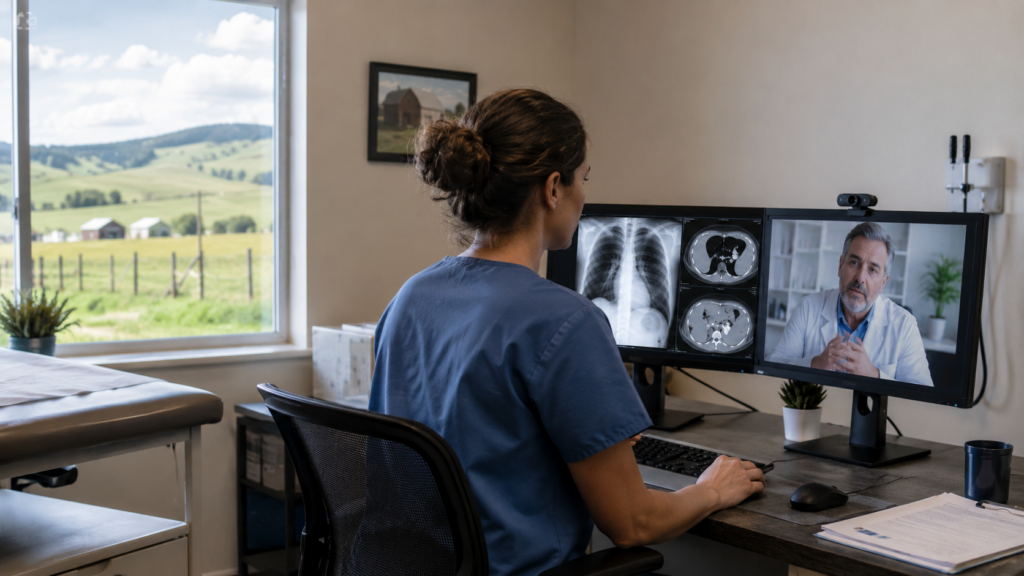
Improving healthcare in rural areas requires more than simply adding equipment or expanding clinic hours. Rural hospitals, urgent care centers, imaging facilities, and private practices need reliable clinical support that helps patients receive timely, accurate care without unnecessary travel or long diagnostic delays. One of the most effective ways to strengthen rural healthcare access is through specialty teleradiology.
Teleradiology allows imaging studies to be interpreted remotely by qualified radiologists, giving rural providers access to diagnostic expertise that may not be available locally. For patients, that can mean faster answers. For healthcare organizations, it can mean better coverage, stronger continuity of care, and more confidence when making treatment decisions.
Why Healthcare in Rural Areas Needs Better Imaging Support
When discussing how to improve healthcare in rural areas, imaging access deserves special attention. Many rural communities face ongoing barriers that make timely diagnosis more difficult, including radiologist shortages, limited subspecialty coverage, after-hours staffing gaps, and long distances between patients and larger medical centers.
These challenges can affect care in several ways:
- Patients may wait longer for imaging results.
- Providers may have limited access to subspecialized interpretations.
- Emergency departments may struggle with after-hours coverage.
- Smaller facilities may depend on transfers that could potentially be avoided.
- Staff burnout can increase when local teams are stretched thin.
Diagnostic imaging often plays a central role in identifying fractures, strokes, infections, cancers, abdominal emergencies, pediatric conditions, and other time-sensitive concerns. When imaging reports are delayed, patient care can be delayed as well.
How to Improve Healthcare in Rural Areas With Specialty Teleradiology
A practical answer to how to improve healthcare in rural areas is to bring specialty expertise directly into the rural care environment through teleradiology. Instead of requiring every rural facility to recruit, hire, and retain a full in-house radiology team, teleradiology connects providers with remote radiologists who can interpret imaging studies quickly and accurately.
This model supports rural healthcare teams by expanding access to:
- Final teleradiology reports for reliable diagnostic documentation
- Preliminary “wet-read” reports for rapid decision support
- Second opinion teleradiology reads for complex or uncertain cases
- After-hours and emergency coverage when local staffing is limited
- Subspecialized interpretations, including pediatric radiology
- Coverage across major modalities, including X-ray, CT, MRI, PET, ultrasound, PET-CT, and 2D and 3D mammography
For rural facilities, this can improve care without requiring patients to leave their community for every diagnostic need.
Expanding Rural Healthcare Access Through Faster Imaging Care
Speed matters in imaging. In rural settings, fast radiology interpretation can help clinicians make quicker decisions about treatment, transfer, discharge, follow-up, or escalation of care. Specialty teleradiology strengthens rural healthcare access by reducing the time between image capture and clinical action.
For example, a rural emergency department may need a rapid CT interpretation after a suspected stroke, trauma, or acute abdominal complaint. An urgent care center may need a same-day X-ray read to confirm a fracture. An imaging center may need dependable final reports to keep patient schedules moving. A private practice may need specialty support for advanced studies or second opinions.
Teleradiology helps close these gaps by giving rural providers a dependable pathway to radiology expertise, even during nights, weekends, holidays, and high-volume periods.
Reducing Travel Burdens for Rural Patients
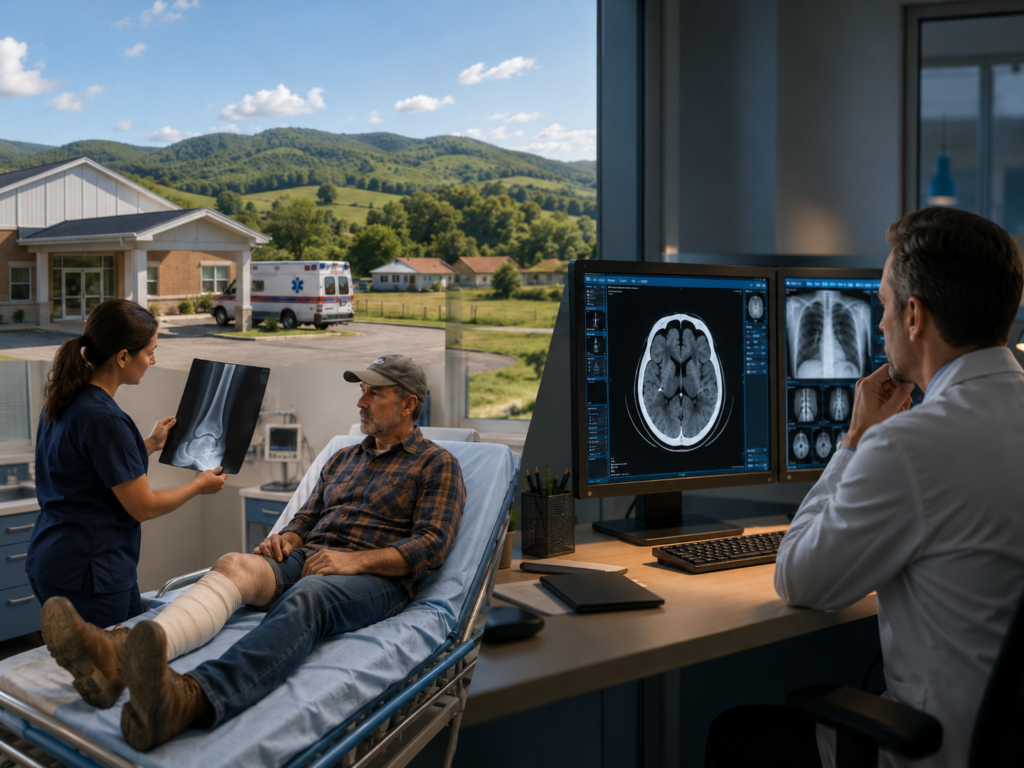
One of the most important ways to improve healthcare in rural areas is to reduce unnecessary travel. Rural patients may have to drive long distances to access specialty care, which can create financial strain, missed work, delayed follow-up, and added stress for families.
Specialty teleradiology helps rural providers keep more imaging-related care local. When patients can receive imaging at a nearby hospital, urgent care center, or imaging facility and have that study interpreted remotely by a qualified radiologist, they may avoid unnecessary referrals or transfers.
This is especially valuable for:
- Older adults with mobility limitations
- Parents seeking pediatric imaging support
- Patients with limited transportation
- Workers who cannot easily take time away from their jobs
- Patients who need follow-up imaging close to home
By supporting local diagnostic capabilities, teleradiology makes rural healthcare more practical and patient-centered.
Supporting Rural Hospitals With After-Hours Radiology Coverage
Many rural hospitals cannot staff radiologists around the clock. Even when they have daytime support, coverage gaps can occur overnight, on weekends, during vacations, or when patient volume increases unexpectedly.
Specialty teleradiology helps rural hospitals maintain continuity by providing flexible, scalable radiology coverage. This can include final reads, preliminary reads, emergency coverage, virtual locum support, and fractional FTE staffing.
Reliable after-hours radiology access can help rural hospitals:
- Improve emergency department responsiveness
- Support inpatient and outpatient imaging workflows
- Reduce delays caused by staffing shortages
- Maintain quality during high-demand periods
- Give clinicians more confidence in time-sensitive cases
This type of support is not just convenient. It can be a critical part of improving patient outcomes in rural communities.
Improving Healthcare in Rural Areas With Subspecialty Radiology
Another key part of how to improve healthcare in rural areas is expanding access to subspecialty expertise. Rural facilities may not have local access to radiologists with experience in pediatric imaging, advanced MRI, PET-CT, mammography, or complex cross-sectional imaging.
Specialty teleradiology can give rural providers access to subspecialized radiologists without the burden of building every specialty service internally. This is especially important when a case requires a more nuanced interpretation or when providers want added confidence before making clinical decisions.
Subspecialty teleradiology may support:
- Pediatric radiology cases
- 2D and 3D mammography
- CT and MRI interpretation
- PET and PET-CT imaging
- Ultrasound interpretation
- Complex second opinion reviews
By strengthening interpretation quality, teleradiology helps rural facilities offer a higher level of diagnostic care close to home.
Helping Rural Providers Operate More Efficiently
Improving healthcare in rural areas is not only about clinical access. It is also about operational sustainability. Rural healthcare organizations often work with limited staff, tight budgets, and unpredictable patient volumes. Teleradiology can help these organizations use resources more efficiently.
Instead of trying to recruit full-time radiology coverage for every shift or specialty need, rural facilities can use teleradiology to fill specific gaps. That may include after-hours coverage, part-time support, overflow reading, vacation coverage, or specialty reads when needed.
This flexible model can help healthcare organizations:
- Manage staffing shortages
- Reduce operational bottlenecks
- Improve report turnaround times
- Support clinicians during peak periods
- Maintain service availability without overextending internal teams
The result is a more resilient imaging workflow that supports both providers and patients.
Building a Better Rural Imaging Workflow
Teleradiology works best when it is integrated into a facility’s daily operations. Rural providers benefit from a partner that understands their workflow, communication preferences, reporting needs, and clinical priorities.
A strong teleradiology program should include:
- Clear turnaround expectations
- Reliable communication channels
- Support for emergency and routine studies
- Coverage across relevant imaging modalities
- Consistent report quality
- Workflow alignment with the facility’s systems
- Ongoing performance review and service optimization
This is where a partnership-based approach can make a major difference.
Specialty Focused Radiology: A Trusted Partner for Rural Healthcare Access
Specialty Focused Radiology is a trusted nationwide teleradiology partner providing fast, accurate diagnostic imaging interpretations for hospitals, urgent care centers, imaging facilities, and private practices across the United States. Our board-certified radiologists offer after-hours coverage, including final reads, preliminary reports, and second opinions across major imaging modalities such as X-ray, CT, MRI, PET, ultrasound, PET-CT, and 2D and 3D mammography. We also provide subspecialized support, including pediatric radiology, to help rural healthcare providers access the expertise they need when they need it.
Our goal is to help healthcare organizations deliver better patient outcomes through reliable, around-the-clock radiology expertise. Whether your facility needs rapid teleradiology reads, final reports, secondary specialty reads, fractional FTE radiology staffing, virtual locum coverage, or pediatric radiology teleradiology, Specialty Focused Radiology provides dependable support designed around your clinical and operational needs.

Promoting Better Healthcare in Rural Areas With sTAAS Teleradiology Services
Specialty Focused Radiology’s sTAAS teleradiology services provide a partnership-based model built for organizations that need reliable access to specialty radiologists without the complexity of building and maintaining that capability in-house. Unlike transactional teleradiology services focused only on read volume, sTAAS is structured around long-term alignment with your clinical, operational, and financial goals.
Through sTAAS, we embed into your workflows, develop site-specific protocols, support structured service-level agreements, and stay accountable through regular operational syncs. For rural hospitals, urgent care centers, imaging facilities, and private practices, this creates a more dependable teleradiology relationship—one that supports faster imaging care, stronger workflow consistency, and better rural healthcare access.
Improve Rural Healthcare Access With Specialty Focused Radiology
When considering how to improve healthcare in rural areas, specialty teleradiology is one of the most practical and impactful solutions available. It helps rural providers expand diagnostic access, reduce patient travel burdens, improve turnaround times, support after-hours care, and bring subspecialty radiology expertise into communities that need it most.
Specialty Focused Radiology is ready to help your organization strengthen healthcare in rural areas with fast, accurate, and reliable teleradiology support. Contact Specialty Focused Radiology today to learn how our nationwide radiology team and sTAAS teleradiology services can help you improve imaging care, support your clinicians, and deliver better outcomes for your patients.
FAQs
Rural healthcare access is often limited by provider shortages, long travel distances, fewer specialty services, and limited after-hours coverage. These challenges can make it harder for patients to receive timely diagnoses and follow-up care.
Teleradiology can help expand rural healthcare access by allowing rural facilities to offer imaging interpretation without needing a full in-house radiology team. Patients can often receive imaging locally while board-certified radiologists provide remote diagnostic interpretations.
Hospitals, urgent care centers, imaging facilities, outpatient clinics, and private practices can all benefit from teleradiology. It is especially valuable for rural organizations that need dependable radiology coverage during nights, weekends, holidays, or high-volume periods.
sTAAS is Specialty Focused Radiology’s partnership-based teleradiology model designed to give healthcare organizations reliable access to specialty radiologists. It goes beyond transactional reading by aligning with each facility’s workflows, protocols, service goals, and long-term clinical needs.