

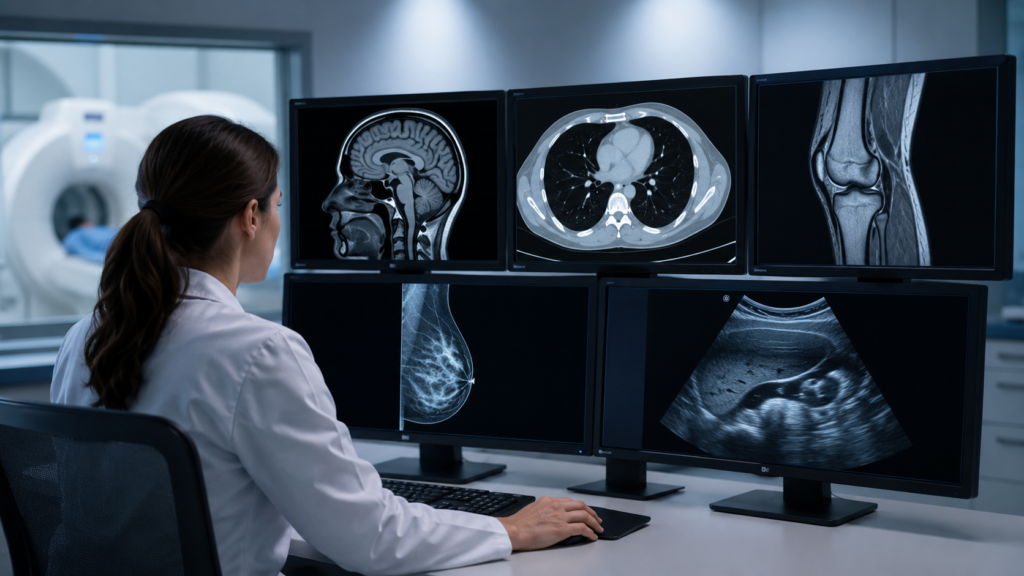
Radiology plays a central role in modern healthcare. From identifying fractures in the emergency room to detecting early-stage cancer, diagnostic imaging helps clinicians make faster, more informed decisions. But radiology is not a single, one-size-fits-all field. Many radiologists pursue advanced expertise in specific areas of the body, patient populations, or imaging techniques.
These focused areas are known as radiology subspecialties. Each subspecialty brings deeper clinical knowledge to a specific type of imaging interpretation, helping care teams diagnose conditions more accurately and choose the right treatment path sooner.
Understanding the most common subspecialties of radiology can help hospitals, urgent care centers, imaging facilities, and private practices better appreciate how subspecialized reads support patient care, operational efficiency, and diagnostic confidence.
What Are Radiology Subspecialties?
Radiology subspecialties are focused areas within diagnostic imaging where radiologists develop advanced expertise in a specific organ system, disease category, imaging modality, or patient group. While general radiologists can interpret a wide range of imaging exams, subspecialized radiologists bring added depth to complex cases.
For example, a neuroradiologist focuses on the brain, spine, head, and neck, while a musculoskeletal radiologist specializes in bones, joints, muscles, and soft tissues. A pediatric radiologist, meanwhile, interprets imaging for infants, children, and adolescents, where anatomy, disease patterns, and radiation-safety considerations differ from adult care.
This focused expertise helps healthcare providers answer important clinical questions more precisely, such as:
- Is this brain finding a stroke, tumor, infection, or trauma-related injury?
- Is a joint abnormality caused by arthritis, ligament damage, or a fracture?
- Does a chest CT show pneumonia, pulmonary embolism, lung cancer, or chronic lung disease?
- Is a pediatric imaging finding normal development or a sign of disease?
Why Subspecialties of Radiology Matter for Accurate Care
The value of subspecialties of radiology goes beyond image interpretation. Subspecialized radiologists help connect imaging findings to real-world clinical decisions. Their expertise can improve diagnostic accuracy, reduce unnecessary follow-up testing, and support more targeted treatment planning.
Subspecialized reads are especially valuable when cases are complex, time-sensitive, or high-risk. In emergency settings, fast and accurate interpretations can guide immediate treatment. In oncology, detailed imaging reports help determine staging, treatment response, and surgical planning. In pediatrics, subspecialty expertise helps ensure imaging is interpreted with age-specific knowledge and appropriate caution.
For healthcare organizations, access to radiology subspecialties can also help address staffing gaps, improve turnaround times, and strengthen confidence among referring physicians.
Common Radiology Subspecialties and What They Diagnose
Neuroradiology
Neuroradiology focuses on imaging of the brain, spine, head, and neck. These radiologists commonly interpret CT, MRI, angiography, and other advanced imaging studies involving the central nervous system.
Neuroradiologists commonly help diagnose:
- Stroke and brain hemorrhage
- Brain tumors and spinal tumors
- Multiple sclerosis and other demyelinating diseases
- Traumatic brain injury
- Spine disorders, including disc herniation and spinal stenosis
- Head and neck infections or masses
- Aneurysms and vascular malformations
This is one of the most important radiology subspecialties for hospitals and emergency departments because neurologic conditions often require urgent decisions.
Musculoskeletal Radiology
Musculoskeletal radiology focuses on bones, joints, muscles, ligaments, tendons, and soft tissues. These specialists are often involved in orthopedic, sports medicine, rheumatology, and trauma-related imaging.
Musculoskeletal radiologists commonly help diagnose:
- Fractures and stress injuries
- Arthritis and joint degeneration
- Ligament and tendon tears
- Bone tumors and soft tissue masses
- Sports injuries
- Spine and extremity trauma
- Infection involving bones or joints
This subspecialty is especially valuable for orthopedic practices, urgent care centers, imaging facilities, and hospitals that frequently evaluate injuries or chronic joint pain.
Body Imaging
Body imaging is a broad subspecialty that focuses on the chest, abdomen, and pelvis. Body imaging radiologists commonly interpret CT, MRI, ultrasound, and other studies involving internal organs.
Body imaging radiologists commonly help diagnose:
- Abdominal pain causes, including appendicitis and bowel obstruction
- Liver, kidney, pancreatic, and adrenal abnormalities
- Lung nodules and chest abnormalities
- Pulmonary embolism
- Abdominal and pelvic cancers
- Kidney stones and urinary tract conditions
- Inflammatory and infectious diseases
Because body imaging covers many organ systems, it is one of the most frequently used subspecialties of radiology across emergency, inpatient, outpatient, and specialty care settings.
Breast Imaging
Breast imaging focuses on the detection and diagnosis of breast disease, including breast cancer. These radiologists interpret screening and diagnostic mammography, 3D mammography, breast ultrasound, and breast MRI.
Breast imaging radiologists commonly help diagnose:
- Breast cancer
- Benign breast lumps and cysts
- Calcifications
- Architectural distortion
- Post-surgical or post-treatment changes
- Findings that require biopsy or follow-up imaging
Breast imaging is essential for early detection and timely intervention. With 2D and 3D mammography, radiologists can identify subtle changes that may not be felt during a physical exam.
Pediatric Radiology
Pediatric radiology focuses on imaging for infants, children, and adolescents. Children are not simply smaller adults; their anatomy, disease patterns, developmental stages, and imaging safety considerations are different.
Pediatric radiologists commonly help diagnose:
- Childhood fractures and trauma
- Congenital abnormalities
- Pediatric infections
- Abdominal pain causes in children
- Neurologic conditions in infants and children
- Pediatric chest and airway conditions
- Childhood tumors
Pediatric radiology is especially important for hospitals, children’s services, urgent care centers, and practices that need reliable interpretations from radiologists who understand pediatric-specific imaging.
Cardiothoracic Radiology
Cardiothoracic radiology focuses on the heart, lungs, airways, chest wall, and blood vessels of the chest. These radiologists commonly interpret chest X-rays, CT scans, cardiac CT, and other thoracic imaging studies.
Cardiothoracic radiologists commonly help diagnose:
- Pneumonia and lung infections
- Lung cancer and pulmonary nodules
- Pulmonary embolism
- Chronic lung disease
- Interstitial lung disease
- Aortic disease
- Chest trauma
- Heart and vascular abnormalities
This subspecialty is valuable in emergency medicine, pulmonology, cardiology, oncology, and inpatient care.
Emergency Radiology
Emergency radiology focuses on urgent imaging performed in emergency departments and acute care settings. These radiologists are skilled at rapidly identifying critical findings across many body systems.
Emergency radiologists commonly help diagnose:
- Traumatic injuries
- Stroke and brain bleeding
- Pulmonary embolism
- Appendicitis
- Bowel obstruction
- Internal bleeding
- Fractures and dislocations
- Acute infections
Emergency radiology supports fast clinical decision-making when minutes matter. It is also one of the areas where teleradiology coverage can be especially helpful for after-hours, overnight, weekend, and high-volume needs.
Abdominal Radiology
Abdominal radiology is closely related to body imaging but focuses more specifically on the organs and structures of the abdomen and pelvis. These radiologists often interpret CT, MRI, ultrasound, and PET-CT exams.
Abdominal radiologists commonly help diagnose:
- Liver disease and liver masses
- Pancreatic abnormalities
- Kidney and adrenal conditions
- Gallbladder and bile duct disease
- Gastrointestinal disorders
- Pelvic masses
- Abdominal cancers
- Inflammatory bowel disease
This subspecialty helps clinicians evaluate complex abdominal symptoms and guide treatment planning for surgical, oncologic, and medical conditions.
Oncologic Imaging
Oncologic imaging focuses on cancer detection, staging, treatment response, and surveillance. These radiologists often interpret CT, MRI, PET, PET-CT, ultrasound, and other imaging studies used throughout the cancer care journey.
Oncologic imaging radiologists commonly help evaluate:
- Tumor location and size
- Cancer staging
- Metastatic disease
- Response to chemotherapy, radiation, or surgery
- Cancer recurrence
- Biopsy targets
- Treatment complications
Among the many radiology subspecialties, oncologic imaging plays a major role in helping care teams personalize treatment and monitor disease over time.
Nuclear Medicine and PET Imaging
Nuclear medicine uses small amounts of radioactive tracers to evaluate organ function, metabolism, and disease activity. PET and PET-CT imaging are commonly used in oncology, cardiology, neurology, and infection evaluation.
Nuclear medicine and PET radiologists commonly help diagnose or evaluate:
- Cancer activity and spread
- Treatment response
- Cardiac perfusion and function
- Neurologic disorders
- Infection or inflammation
- Thyroid and parathyroid conditions
- Bone metastases
Unlike many imaging exams that focus primarily on anatomy, nuclear medicine and PET imaging can provide functional information that helps clinicians understand how disease is behaving.
Interventional Radiology
Interventional radiology differs from purely diagnostic radiology because it involves image-guided procedures. Interventional radiologists use imaging tools such as ultrasound, fluoroscopy, CT, or MRI to guide minimally invasive treatments.
Interventional radiologists commonly perform or support:
- Image-guided biopsies
- Drainage procedures
- Vascular access procedures
- Tumor ablation
- Embolization procedures
- Treatment for blocked blood vessels
- Pain management injections
Although interventional radiology is procedure-based, diagnostic imaging still plays an important role in identifying the condition, planning the procedure, and monitoring results.
How Radiology Subspecialties Support Smarter Treatment
When imaging is interpreted by the right specialist, the report becomes more than a description of what appears on a scan. It becomes a clinically useful roadmap that can guide next steps.
Subspecialized radiology can support smarter treatment by helping providers:
- Identify subtle or complex abnormalities
- Distinguish urgent findings from non-urgent findings
- Recommend appropriate follow-up imaging when needed
- Support surgical or procedural planning
- Improve communication between radiology and referring clinicians
- Reduce diagnostic uncertainty
- Improve confidence in treatment decisions
For healthcare organizations, access to the right subspecialties of radiology can help improve care quality while also supporting more efficient workflows.
When Healthcare Providers Need Access to Subspecialized Radiology
Not every facility has every subspecialist available in-house. This can be especially challenging for smaller hospitals, rural facilities, urgent care centers, outpatient imaging centers, and private practices. Even larger organizations may experience coverage gaps due to volume spikes, vacations, after-hours demand, or recruitment challenges.
Subspecialized teleradiology helps bridge this gap by giving providers access to experienced radiologists without requiring them to build and maintain every specialty internally.
Common use cases include:
- Overnight and weekend imaging coverage
- Emergency department support
- Pediatric radiology coverage
- Second opinion reads
- Final report coverage
- Preliminary wet-read reports
- Overflow support during high-volume periods
- Fractional radiology staffing
- Virtual locum coverage
Specialty Focused Radiology: A Trusted Nationwide Teleradiology Partner
Specialty Focused Radiology is a trusted teleradiology partner providing fast, accurate diagnostic imaging interpretations for hospitals, urgent care centers, imaging facilities, and private practices across the United States. Our board-certified radiologists offer after-hours coverage, including final reads, preliminary reports, and second opinions across major imaging modalities such as X-ray, CT, MRI, PET, ultrasound, PET-CT, and 2D and 3D mammography.
We also provide subspecialized coverage, including pediatric radiology, to help healthcare organizations strengthen clinical confidence and maintain reliable radiology support. Whether a facility needs after-hours emergency coverage, part-time fractional FTE support, virtual locum services, rapid wet reads, or subspecialty second opinions, Specialty Focused Radiology delivers dependable expertise designed around each organization’s needs.

How Our sTAAS Teleradiology Model Supports Subspecialties of Radiology
Specialty Focused Radiology’s sTAAS model is a partnership-based teleradiology solution built to give healthcare organizations reliable access to specialty radiologists without the complexity of building and maintaining that capability in-house.
Unlike transactional teleradiology services that focus only on read volume, sTAAS is structured around long-term clinical, operational, and financial alignment. We embed into your workflows, develop site-specific protocols, support structured service-level agreements, and maintain regular operational syncs. This helps your organization access the radiology subspecialties you need while preserving consistency, accountability, and personalized service.
With sTAAS, providers can strengthen coverage, reduce staffing pressure, and support better patient outcomes through a smarter, more collaborative teleradiology partnership.
Choose the Right Radiology Subspecialties for Better Patient Care
The most common radiology subspecialties each play a distinct role in diagnosis, treatment planning, and patient care. From neuroradiology and musculoskeletal imaging to pediatric radiology, breast imaging, emergency radiology, and PET-CT interpretation, subspecialized expertise helps providers make more confident decisions.
As healthcare organizations face increasing imaging demand, staffing challenges, and the need for faster turnaround times, access to the right subspecialties of radiology can make a measurable difference.
Specialty Focused Radiology is ready to help your organization improve coverage, increase diagnostic confidence, and deliver reliable imaging interpretations around the clock. Contact Specialty Focused Radiology today to get started with a trusted nationwide teleradiology partner and learn how our sTAAS model can support your team.
FAQs
The most common radiology subspecialties include neuroradiology, musculoskeletal radiology, body imaging, breast imaging, pediatric radiology, cardiothoracic radiology, emergency radiology, abdominal radiology, nuclear medicine, and interventional radiology. Each subspecialty focuses on different conditions, imaging exams, or patient needs.
Radiology subspecialties improve patient care by providing more precise imaging interpretations for specific clinical questions. This can reduce diagnostic uncertainty, guide treatment decisions, support surgical planning, and help clinicians choose the most appropriate next steps.
A healthcare facility may benefit from subspecialized teleradiology when it needs after-hours coverage, overflow support, pediatric expertise, emergency reads, second opinions, or access to specialists not available in-house. Teleradiology can help hospitals, urgent care centers, imaging facilities, and private practices maintain reliable diagnostic support.
Radiology subspecialties may use imaging modalities such as X-ray, CT, MRI, ultrasound, PET, PET-CT, mammography, and 3D mammography. The best modality depends on the patient’s symptoms, the body area being examined, and the clinical question being answered.